











































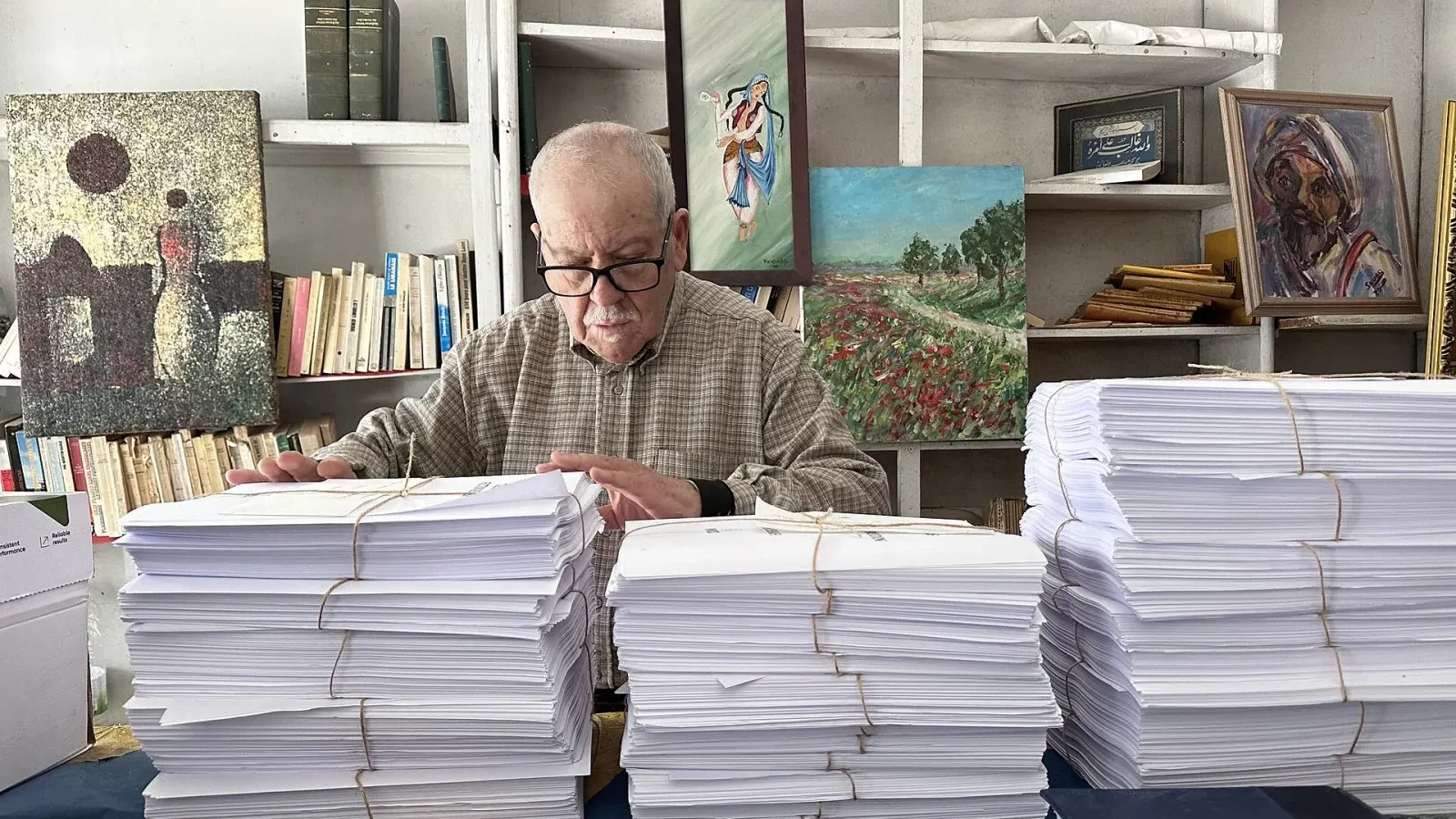
A bookbinding workshop: the joy of stitching your own notebook
In a bookbinding studio, we learned how a handmade notebook comes together, from folding paper and sewing the spine to the board cover and cloth binding.
Table of contents
With hundreds of notebooks on stationery shelves, making your own may seem unnecessary at first. But folding the sheets one by one, sewing them with needle and thread and covering the boards with a fabric you chose yourself creates a very different kind of bond. During a day at bookbinder Nora Tate's studio, we learned every stage of a simple stitched notebook. Tate says binding is a craft that demands patience and attention, but is deeply relaxing.
Choosing and folding the paper
Choosing and folding the paper is the quiet beginning of bookbinding. In her studio, Nora Tate first teaches the grain direction of paper: the fibers should run parallel to the spine, otherwise the pages curl easily. To find it, we bend the paper and test its resistance in both directions. When the grain is right, the page opens easily and lies flat.
Then we fold the sheets in half. Each fold is pressed down neatly with a bone folder, and several sheets are nested together to form signatures. Tate explains that we can adjust the notebook's thickness by the number of signatures. It's important not to rush at this stage; a crooked fold shows itself in every later stage and is hard to fix. That's why we keep lining up the edges of the signatures to check them as we fold.
Writing in a notebook you stitched yourself makes you take more care with your words.
Sarah Bennett
The rhythm of spine stitching
The rhythm of spine stitching is the most meditative moment in the bookbinding studio. First, sewing holes are pierced in the signatures with an awl, then they are sewn one by one with waxed thread and a blunt needle. Pulling the thread too tight tears the paper, while leaving it too loose makes the notebook fall apart. Tate says you learn the right tension with your hands over time.
To keep the stitching even, you mustn't break the rhythm: through the hole, pull, knot, on to the next signature. Most workshop participants relax after stitching the first signature; conversation fades, and the only sound in the room is the faint whisper of thread passing through paper. Tate believes it's this repetitive motion that makes bookbinding so restful.
Cover and finishing
In the cover and finishing stage, board, cloth and glue come into play. The boards are cut slightly larger than the notebook, glued onto the cloth and the corners folded over. The sewn signatures are then glued into the cover and left overnight, first under light and then under heavy pressure. Impatience here can make the cover warp; Tate reminds us that spreading the glue thinly and evenly is just as important as the waiting time.
| Topic | Craft |
|---|---|
| Highlights | handmade, creative process, minimalism |
| Reading time | 5 minutes |
| Written by | Sarah Bennett |
Key takeaways
- Paper grain direction and neat folding are the foundation of a notebook.
- Spine stitching is a rhythmic, patient and restful process.
- Leaving the cover under pressure overnight prevents warping.
Finally, the endpapers are pasted down and the notebook takes shape. The choice of cloth is up to personal taste: it can be linen, cotton or even a piece of an old shirt. Tate says that when we write in a notebook we stitched ourselves, we take more care with our words. At the end of the day, everyone leaves with their own notebook in their bag; its small flaws make it one of a kind.
What do you think about this post?
Leave a comment